 Add to Chrome
 Add to Firefox
 Add to Edge
PhoneWorld: Scaling Phone-Use Agent Environments
May 28, 2026
A central bottleneck for phone-use agents is that controllable, reproducible environments covering real mobile behavior are hard to build at scale. Existing mobile-agent benchmarks have made important progress on evaluation, but they do not by themselves provide a scalable way to construct many new phone-use environments. We present PhoneWorld, a reusable pipeline that converts real GUI trajectories and screenshots into controllable phone-use environments, executable tasks, automatic verifiers, and training rollouts. Rather than hand-building one mobile benchmark at a time, PhoneWorld uses real trajectories to recover which screens matter, how screens connect, which interactions must change environment state, and which user goals admit automatic verification. From these signals, it builds runnable mock Android apps backed by read-only app content and mutable state, then derives executable tasks, rule-based verifiers, and training rollouts from the same environments. In its current instantiation, PhoneWorld covers 34 apps across 16 domains, spanning common consumer mobile behaviors such as search, browsing, shopping, booking, media, and social interaction. Under a fixed training budget, replacing 10K steps from an auxiliary AndroidWorld corpus in an AndroidWorld-based baseline with broad PhoneWorld supervision improves all four evaluation benchmarks at once, raising HYMobileBench by 17.7 points, AndroidControl by 6.0 points, AndroidWorld by 14.7 points, and PhoneWorld by 52.5 points. We then study two additional scaling questions: increasing the amount of PhoneWorld supervision strongly improves PhoneWorld performance, and under a fixed PhoneWorld budget, expanding app coverage yields even larger gains. Overall, PhoneWorld shifts the focus from building one mobile benchmark at a time to scaling the supply of phone-use environments themselves.

The Missing Piece in Pre-trained Model Evaluation: Reward-Guided Decoding Unlocks Task-Oriented Behavior Without Parameter Updates
May 27, 2026With the rapid progress of large language models (LLMs), reliably evaluating the capabilities of pre-trained LLMs has become increasingly important. The challenge is that base pre-trained models are optimized for next-token prediction and often fail to follow instructions or produce well-formed answers under standard prompting and direct decoding. As a result, benchmark performance can conflate model capability with decoding-induced failures to produce task-oriented outputs, while exposing such behavior often relies on costly post-training. Recent decodingonly approaches attempt to reshape output distributions, but such methods can be inefficient and brittle across open-ended tasks. To address these limitations, we propose Energy-Based Decoding (EBD), a training-free, reward-guided framework for activating task-oriented behaviors from frozen pre-trained LLMs across both open-ended and objective tasks. EBD augments decoding with an external lightweight reward model, steering generations toward high-utility responses while anchoring them to the pre-trained model prior through a reward-tilted target distribution. We show that EBD shifts base-model outputs toward more instructionfollowing behavior, increasing behavioral similarity to post-trained counterparts and enabling a fairer inference-time evaluation of accessible pre-trained-model behavior. Empirically, EBD outperforms baselines across five models and six benchmarks, improving Qwen3-8B-Base on AlpacaEval2.0 from 8.8 to 44.5, reducing Mistral-7B Math500 latency by 18.9x relative to prior decoding work, and remaining robust to reward-model size.
Do Phone-Use Agents Respect Your Privacy?
Apr 02, 2026We study whether phone-use agents respect privacy while completing benign mobile tasks. This question has remained hard to answer because privacy-compliant behavior is not operationalized for phone-use agents, and ordinary apps do not reveal exactly what data agents type into which form entries during execution. To make this question measurable, we introduce MyPhoneBench, a verifiable evaluation framework for privacy behavior in mobile agents. We operationalize privacy-respecting phone use as permissioned access, minimal disclosure, and user-controlled memory through a minimal privacy contract, iMy, and pair it with instrumented mock apps plus rule-based auditing that make unnecessary permission requests, deceptive re-disclosure, and unnecessary form filling observable and reproducible. Across five frontier models on 10 mobile apps and 300 tasks, we find that task success, privacy-compliant task completion, and later-session use of saved preferences are distinct capabilities, and no single model dominates all three. Evaluating success and privacy jointly reshuffles the model ordering relative to either metric alone. The most persistent failure mode across models is simple data minimization: agents still fill optional personal entries that the task does not require. These results show that privacy failures arise from over-helpful execution of benign tasks, and that success-only evaluation overestimates the deployment readiness of current phone-use agents. All code, mock apps, and agent trajectories are publicly available at~ https://github.com/FreedomIntelligence/MyPhoneBench.
Kimi K2.5: Visual Agentic Intelligence
Feb 02, 2026We introduce Kimi K2.5, an open-source multimodal agentic model designed to advance general agentic intelligence. K2.5 emphasizes the joint optimization of text and vision so that two modalities enhance each other. This includes a series of techniques such as joint text-vision pre-training, zero-vision SFT, and joint text-vision reinforcement learning. Building on this multimodal foundation, K2.5 introduces Agent Swarm, a self-directed parallel agent orchestration framework that dynamically decomposes complex tasks into heterogeneous sub-problems and executes them concurrently. Extensive evaluations show that Kimi K2.5 achieves state-of-the-art results across various domains including coding, vision, reasoning, and agentic tasks. Agent Swarm also reduces latency by up to $4.5\times$ over single-agent baselines. We release the post-trained Kimi K2.5 model checkpoint to facilitate future research and real-world applications of agentic intelligence.
CoRT: Code-integrated Reasoning within Thinking
Jun 12, 2025Large Reasoning Models (LRMs) like o1 and DeepSeek-R1 have shown remarkable progress in natural language reasoning with long chain-of-thought (CoT), yet they remain inefficient or inaccurate when handling complex mathematical operations. Addressing these limitations through computational tools (e.g., computation libraries and symbolic solvers) is promising, but it introduces a technical challenge: Code Interpreter (CI) brings external knowledge beyond the model's internal text representations, thus the direct combination is not efficient. This paper introduces CoRT, a post-training framework for teaching LRMs to leverage CI effectively and efficiently. As a first step, we address the data scarcity issue by synthesizing code-integrated reasoning data through Hint-Engineering, which strategically inserts different hints at appropriate positions to optimize LRM-CI interaction. We manually create 30 high-quality samples, upon which we post-train models ranging from 1.5B to 32B parameters, with supervised fine-tuning, rejection fine-tuning and reinforcement learning. Our experimental results demonstrate that Hint-Engineering models achieve 4\% and 8\% absolute improvements on DeepSeek-R1-Distill-Qwen-32B and DeepSeek-R1-Distill-Qwen-1.5B respectively, across five challenging mathematical reasoning datasets. Furthermore, Hint-Engineering models use about 30\% fewer tokens for the 32B model and 50\% fewer tokens for the 1.5B model compared with the natural language models. The models and code are available at https://github.com/ChengpengLi1003/CoRT.
Learning from Peers in Reasoning Models
May 12, 2025Large Reasoning Models (LRMs) have the ability to self-correct even when they make mistakes in their reasoning paths. However, our study reveals that when the reasoning process starts with a short but poor beginning, it becomes difficult for the model to recover. We refer to this phenomenon as the "Prefix Dominance Trap". Inspired by psychological findings that peer interaction can promote self-correction without negatively impacting already accurate individuals, we propose **Learning from Peers** (LeaP) to address this phenomenon. Specifically, every tokens, each reasoning path summarizes its intermediate reasoning and shares it with others through a routing mechanism, enabling paths to incorporate peer insights during inference. However, we observe that smaller models sometimes fail to follow summarization and reflection instructions effectively. To address this, we fine-tune them into our **LeaP-T** model series. Experiments on AIME 2024, AIME 2025, AIMO 2025, and GPQA Diamond show that LeaP provides substantial improvements. For instance, QwQ-32B with LeaP achieves nearly 5 absolute points higher than the baseline on average, and surpasses DeepSeek-R1-671B on three math benchmarks with an average gain of 3.3 points. Notably, our fine-tuned LeaP-T-7B matches the performance of DeepSeek-R1-Distill-Qwen-14B on AIME 2024. In-depth analysis reveals LeaP's robust error correction by timely peer insights, showing strong error tolerance and handling varied task difficulty. LeaP marks a milestone by enabling LRMs to collaborate during reasoning. Our code, datasets, and models are available at https://learning-from-peers.github.io/ .
RealCritic: Towards Effectiveness-Driven Evaluation of Language Model Critiques
Jan 24, 2025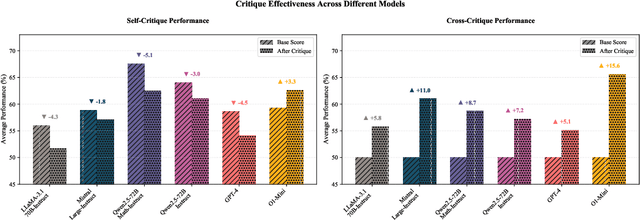
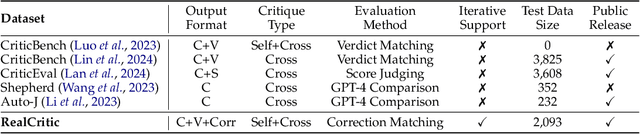
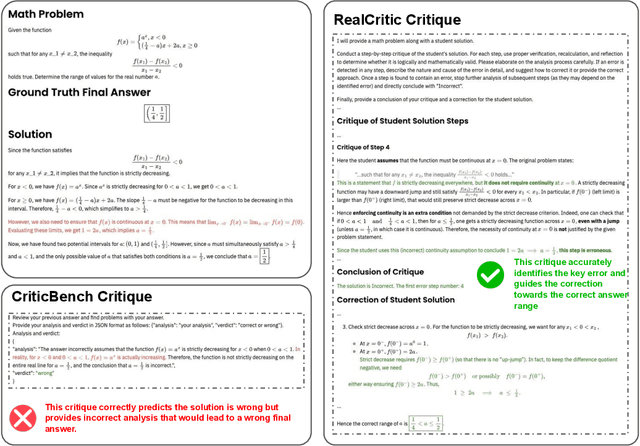
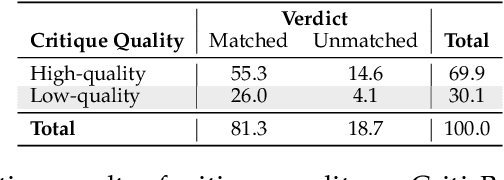
Critiques are important for enhancing the performance of Large Language Models (LLMs), enabling both self-improvement and constructive feedback for others by identifying flaws and suggesting improvements. However, evaluating the critique capabilities of LLMs presents a significant challenge due to the open-ended nature of the task. In this work, we introduce a new benchmark designed to assess the critique capabilities of LLMs. Unlike existing benchmarks, which typically function in an open-loop fashion, our approach employs a closed-loop methodology that evaluates the quality of corrections generated from critiques. Moreover, the benchmark incorporates features such as self-critique, cross-critique, and iterative critique, which are crucial for distinguishing the abilities of advanced reasoning models from more classical ones. We implement this benchmark using eight challenging reasoning tasks. We have several interesting findings. First, despite demonstrating comparable performance in direct chain-of-thought generation, classical LLMs significantly lag behind the advanced reasoning-based model o1-mini across all critique scenarios. Second, in self-critique and iterative critique settings, classical LLMs may even underperform relative to their baseline capabilities. We hope that this benchmark will serve as a valuable resource to guide future advancements. The code and data are available at \url{https://github.com/tangzhy/RealCritic}.
Enabling Scalable Oversight via Self-Evolving Critic
Jan 10, 2025Despite their remarkable performance, the development of Large Language Models (LLMs) faces a critical challenge in scalable oversight: providing effective feedback for tasks where human evaluation is difficult or where LLMs outperform humans. While there is growing interest in using LLMs for critique, current approaches still rely on human annotations or more powerful models, leaving the issue of enhancing critique capabilities without external supervision unresolved. We introduce SCRIT (Self-evolving CRITic), a framework that enables genuine self-evolution of critique abilities. Technically, SCRIT self-improves by training on synthetic data, generated by a contrastive-based self-critic that uses reference solutions for step-by-step critique, and a self-validation mechanism that ensures critique quality through correction outcomes. Implemented with Qwen2.5-72B-Instruct, one of the most powerful LLMs, SCRIT achieves up to a 10.3\% improvement on critique-correction and error identification benchmarks. Our analysis reveals that SCRIT's performance scales positively with data and model size, outperforms alternative approaches, and benefits critically from its self-validation component.
Second Language (Arabic) Acquisition of LLMs via Progressive Vocabulary Expansion
Dec 16, 2024

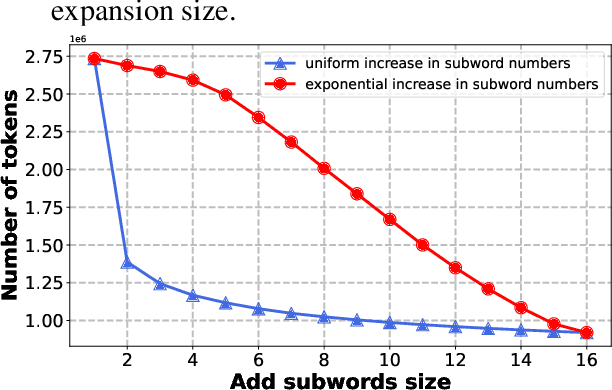

This paper addresses the critical need for democratizing large language models (LLM) in the Arab world, a region that has seen slower progress in developing models comparable to state-of-the-art offerings like GPT-4 or ChatGPT 3.5, due to a predominant focus on mainstream languages (e.g., English and Chinese). One practical objective for an Arabic LLM is to utilize an Arabic-specific vocabulary for the tokenizer that could speed up decoding. However, using a different vocabulary often leads to a degradation of learned knowledge since many words are initially out-of-vocabulary (OOV) when training starts. Inspired by the vocabulary learning during Second Language (Arabic) Acquisition for humans, the released AraLLaMA employs progressive vocabulary expansion, which is implemented by a modified BPE algorithm that progressively extends the Arabic subwords in its dynamic vocabulary during training, thereby balancing the OOV ratio at every stage. The ablation study demonstrated the effectiveness of Progressive Vocabulary Expansion. Moreover, AraLLaMA achieves decent performance comparable to the best Arabic LLMs across a variety of Arabic benchmarks. Models, training data, benchmarks, and codes will be all open-sourced.
Omni-MATH: A Universal Olympiad Level Mathematic Benchmark For Large Language Models
Oct 10, 2024
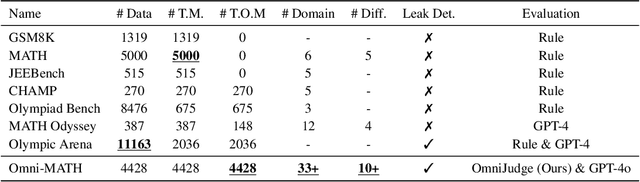

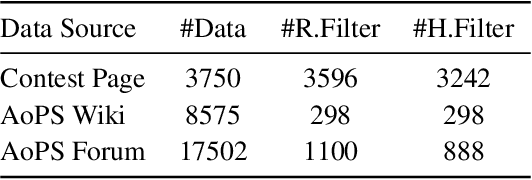
Recent advancements in large language models (LLMs) have led to significant breakthroughs in mathematical reasoning capabilities. However, existing benchmarks like GSM8K or MATH are now being solved with high accuracy (e.g., OpenAI o1 achieves 94.8% on MATH dataset), indicating their inadequacy for truly challenging these models. To bridge this gap, we propose a comprehensive and challenging benchmark specifically designed to assess LLMs' mathematical reasoning at the Olympiad level. Unlike existing Olympiad-related benchmarks, our dataset focuses exclusively on mathematics and comprises a vast collection of 4428 competition-level problems with rigorous human annotation. These problems are meticulously categorized into over 33 sub-domains and span more than 10 distinct difficulty levels, enabling a holistic assessment of model performance in Olympiad-mathematical reasoning. Furthermore, we conducted an in-depth analysis based on this benchmark. Our experimental results show that even the most advanced models, OpenAI o1-mini and OpenAI o1-preview, struggle with highly challenging Olympiad-level problems, with 60.54% and 52.55% accuracy, highlighting significant challenges in Olympiad-level mathematical reasoning.